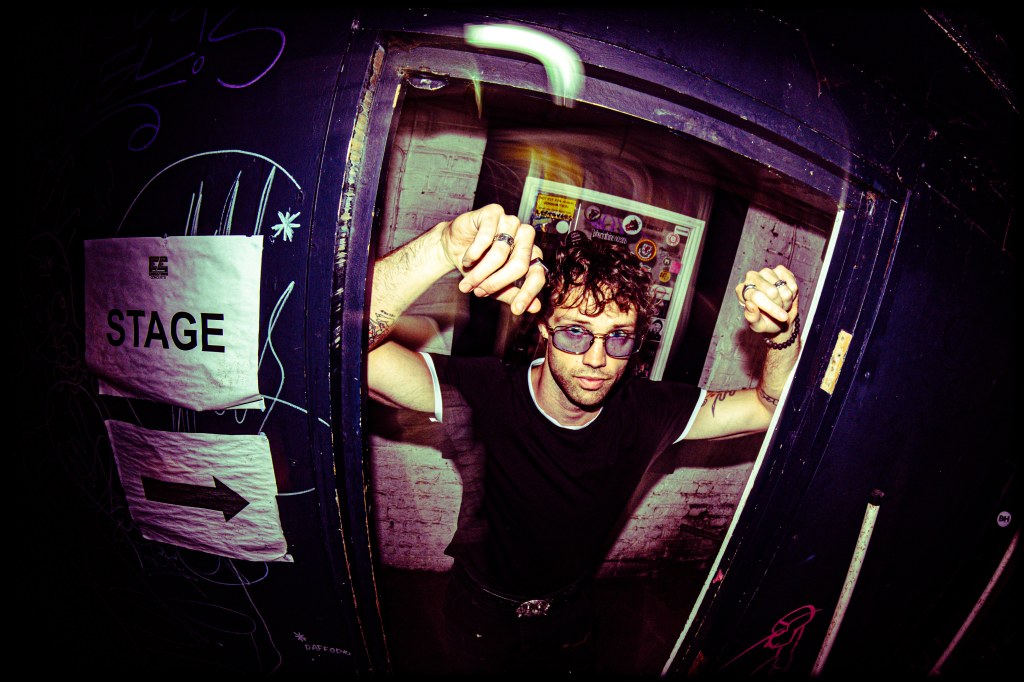
After nearly a decade away, Nodaway is officially back, but for singer-songwriter Chris Jobe returning to the project isn’t about picking up exactly where he left off.
It’s about starting again. Last month, Chris returned with 777 Seasons, a seven-track album that marks the first new Nodaway project in nearly a decade.
Written and produced by Jobe and recorded largely live to tape, the album trades overly polished production for something deliberately more human: real musicians, imperfections and the kind of emotion you can’t necessarily clean up in a studio.
That approach is especially meaningful considering what happened while Nodaway was away. During the project’s hiatus, Jobe says AI-generated music began appearing on Nodaway’s streaming pages, an experience that unexpectedly reminded him that people were still listening to the music he had released years earlier.
Combined with major changes in his own life, including a move to London and a serious motorcycle accident in Costa Rica, it eventually helped lead him back to Nodaway.
The accident also became part of the story behind 777 Seasons. After crashing his motorcycle, Jobe looked up and saw “777” on a passing license plate, a moment he interpreted as a reminder of just how lucky he was to have survived.
Each of the album’s seven songs is now connected to a different angel number and meaning, including “Cali Waves,” which represents 444 and a new beginning.
The track finds Jobe caught somewhere between his new life in London and the California beaches he left behind. Its official music video follows that same divide, moving between rainy London and sunny Los Angeles while capturing the homesickness, freedom and slightly chaotic sense of humor behind the song.
But 777 Seasons is about more than Nodaway returning, it’s also the result of an artist who has spent the last decade changing, moving, starting over and learning to trust himself.
From leaving Los Angeles for London and recording live at the legendary Konk Studios to zip-tying CD players to light poles so strangers could discover his music outside of an algorithm, Jobe has found himself increasingly drawn toward something simple: genuine human connection.
That idea comes up again and again throughout our conversation: connection to music, connection to other people and, maybe most importantly, connection to yourself.
I caught up with Chris to talk about bringing Nodaway back after nearly a decade, the story behind 777 Seasons, his motorcycle accident, “Cali Waves,” AI in music, rediscovering his confidence and what comes next.
Make sure you’re keeping up with all things Nodaway here!
DL: Chris, thank you so much for taking the time to speak with me! First and foremost, how are you?
Nodaway: I’m good! Finally over jet lag and a cold traveling around London.
DL: It’s been nearly a decade since Nodaway released a new album. Why did 777 Seasons feel like the right project to bring Nodaway back?
Nodaway: I had stepped away to pursue another genre and produce for other artists. The last couple of years, I got tired of hearing overproduced music, and that coincided with a bunch of big life moments, a move to London and AI spamming my streaming pages which alerted me that I still had about 30K people streaming Nodaway’s only five songs a decade later. So it was time to put out something human, raw and indie to fit Nodaway.
DL: Let’s talk about “Cali Waves.” It feels like a love letter to California, but there’s also this sense of homesickness and even a little frustration underneath it. What was going through your head when you wrote the song?
Nodaway: Exactly that. I was loving London, but I think a part of my soul only feels satisfied on the beach, getting thrown around by the waves surfing. I was sitting in a small writing room in London on a rainy day absolutely dying for a surf. Yearning for a moment of oneness and completeness that I’m not sure how to get elsewhere yet, well, maybe I found that recently at a sold-out show in London.
DL: The music video really brings that feeling to life by going back and forth between rainy London and sunny California. When you were writing the song, did you already have that visual in your head, or did the concept for the video come later?
Nodaway: I think it came later while I was moving back to London for the summer, and I thought, “Oh, it would be so cool to have both places in one video.” So I shot in February in LA and July in London.
DL: I HAVE to ask about the lyric, “I just want a big California wave to wrap me up and spit into my face.” It’s such a specific line and immediately sticks with you. Where did that come from?
Nodaway: It’s a bit less sexual than it sounds, lol. In surfing, when you catch a barrel, which is when the wave curls over you while you’re still on the board, kind of creating a tunnel, the water gets pushed out from the beginning of the tunnel behind you out to the exit. We call that spray or spit. And there’s no better feeling than getting trapped inside of a wave and the spit hitting you in the face as you exit.
DL: “Cali Waves” represents 444 in the album’s angel-number concept. What does 444 mean to you personally, and why did it make sense for this particular song?
Nodaway: 444 means a new start, a new beginning. And with the opening of every chapter comes the closing of another, and it’s been very emotional and hard to leave LA because of my friends and the hikes and beach.
DL: The story behind 777 Seasons is pretty wild in itself. After surviving your motorcycle accident in Costa Rica, you started noticing angel numbers everywhere before eventually coming across “777.” Did going through something that serious change your perspective on life or the kind of music you wanted to make?
Nodaway: I actually saw 777 right off the bat. I was picking myself and my totaled bike off the ground, looked up and saw 777 on a license plate passing me by. It was absolutely mental. It 100% made me want to make music that felt a little bit deeper and more emotional, and more serious.
I was writing a ton of party pop songs in Costa Rica and doing a lot of the partying as well, lol, and I think that did play a role in my accident, as well as the universe kind of stopping me and saying, “Slow down!” That 777 on the license plate I interpreted as the universe saying, “Wow, you’re quite lucky,” because so many people had died in that very spot where I wrecked.
DL: Something I really love about this album is that it was recorded almost entirely live to tape. We’re living in a time where basically every tiny imperfection can be fixed in the studio, so why was it important for you to leave some of that humanity and imperfection in the record? It sounds incredible, by the way.
Nodaway: Thank you so much! I wanted it to feel real and raw and very human because of all the AI slop that had been put on my streaming platforms by someone who was siphoning streams from Nodaway.
I also just wanted to make something that was different from everything else I was hearing. Everything was so safe and perfect that it felt boring. So I wanted to create something that was imperfect and exciting and human.
We put way too much pressure on ourselves as humans these days to have a perfect outward appearance and perfect inward peace, but we are a part of nature and nature is perfectly imperfect. We gotta love ourselves, warts and all.
DL: You also did something really cool around the release of 777 Seasons that feels almost rebellious in 2026: putting portable CD players and headphones out in public so people could literally stumble across the album and listen to it “in the wild.” Where did that idea come from?
Nodaway: I’m pretty sure I saw someone in Los Angeles do it maybe three or four years ago through an Instagram post. I also tried it in LA and it didn’t work as well, but for some reason in London people actually really stop and listen. Then they came to the show and I met them, and now there is this community buzzing around old, semi-broken CD players that have been zip-tied to light poles. It’s fun!
DL: I love that the whole idea was about bringing music back into real life. We’re so used to an algorithm deciding what song we hear next that there’s something special about physically discovering music again. Do you think we’ve lost some of that connection to music because of streaming and social media?
Nodaway: I think as society as a whole, we’ve completely lost the whole point of connection. Everything has been put into ones and zeros, which is the foundation of coding, and human interaction and connection is not as neat and pretty as ones and zeros.
As a result, we don’t feel as fulfilled by getting these little dopamine dumps. It leaves us feeling hollow and empty and also craving more dopamine dumps. It’s quite a vicious cycle.
So the solution is connection, not only with physical mediums like music and people in a room at a show, but also connection with ourselves. When we find ourselves feeling connected with our own consciousness, we can find deeper connection with others, and of course with the arts seeing humans play at a show or putting on headphones attached to a CD player attached to a light pole.
DL: Did you ever get to actually watch someone discover one of the CD players and listen without knowing you were behind it? I feel like seeing a stranger experience your music that way would be pretty surreal.
Nodaway: I have caught two people listening to my music. The rest of the time it has been friends sending me videos of strangers listening to the music. The first time I saw someone listening, I was like, “Oh my gosh, I can’t believe this is actually working!”
DL: Between recording 777 Seasons largely live to tape, putting CD players out on the street and everything that happened with AI-generated songs appearing on your streaming pages, there seems to be this bigger theme of choosing human connection over algorithms. Was that something you intentionally set out to say with this era, or did all of those pieces just naturally come together?
Nodaway: I think all those pieces have naturally just kind of come together, including moving to London, where connection is much easier to cultivate because of the infrastructure and how easy it is to travel around the city.
LA is really quite isolated and you have to try really hard to maintain connection with someone across the city. I actually really haven’t realized this until you pointed it out! Thanks!
DL: You’ve lived and made music in places like Nashville, Los Angeles and London. How has each city influenced who you are creatively?
Nodaway: Nashville is an absolutely amazing place to grow as a musician. The community is so incredibly supportive and beautiful. People there are so sweet and kind, and Southern hospitality is truly a thing and so is the lack of direct criticism, which I found challenging at that age.
Nashville was quite a fertile place for me to develop my skills, which I really needed. But it also was a place that was very easy to become over-commercialized and focus too much on the literal storytelling of a song instead of the song’s pure emotion.
Because I lived by the beach in Los Angeles and didn’t have too many industry connections there, I was really able to detach from traditional songwriting and get back to how I approached songwriting as a kid and teenager. I was also quite isolated by the beach since most of the industry was in the Valley, so I got a lot more comfortable with writing beachier and stranger tunes all by myself.
London has challenged me the hardest. The musicians that I play with are some of the top touring musicians in the world, and I’ve been going to jams lately which are fully improvised. I’ve been singing with random strangers who happen to be absolutely incredible musicians.
The first time we recorded to tape, which is nerve-racking because you only get so many takes. I remember listening to the other guys in the room just being like, “Holy smokes. These guys are absolutely insane. How do I step it up?”
I also think because it’s a bit more overcast here and there’s no ocean to rely on, it makes me go a bit more inward and create more because I feel like that’s the only thing I have to really do here outside of grabbing a pint with mates and cheering on Arsenal.
London has such a love for indie, rock and jazz, and I’m quite fond of those genres and trying to combine them at times. So that has been pretty magical, to find other musicians and now new fans that are really understanding of that effort and vision.
Also, because it’s a new city and I don’t know too many people, I constantly have to go out of my shell to do something risky, like busk on the street and hand out flyers or put up CD players.
DL: If you could sit down with the version of yourself who stepped away from Nodaway almost a decade ago and play him 777 Seasons, what do you think he’d be most surprised to hear?
Nodaway: He’d be very shocked to hear that the management/label company he signed to as a pop act would not lead to anything that lasting, and that in 10 years people would still discover that original EP and drive nearly 50 miles to come to a show.
I think at 21 I was pretty certain that I was going to be the next pop sensation, lol. The many ego deaths I’ve had in the last decade have been super helpful to make more honest and vulnerable, and better, music.
DL: With everything you’ve gone through and everything that ultimately led you to this album, what’s one thing you know about yourself now that you didn’t know when Nodaway first started?
Nodaway: Not to sound conceited, but I am now confident that I am good enough. Kind of in every aspect of life, I feel like I actually am worthy, and I really struggled with feeling worthy in so many ways as a kid.
DL: Now that Nodaway is officially back, what’s next? What can fans expect after 777 Seasons and “Cali Waves”?
Nodaway: Album two is in the works, and it’s a little bit rockier than the last one. It sounds pretty sick so far.

